
AAAR at the University of Illinois at Urbana-Champaign
Tahsina Alam
AAAR@UIUC began the semester with a strong focus on community building and professional development. In December 2025, we hosted a Pre-AGU Practice Party to support members preparing for AGU 2025. The session created a structured space for students to rehearse presentations, receive direct and constructive feedback, and refine their messaging before the conference. Later that week, members reconnected at the AAAR@UIUC Meetup Dinner during AGU, strengthening ties beyond formal sessions and reinforcing our chapter’s collaborative culture.
In January, we continued our technical programming by hosting the AS&T Lecture featuring Ed Neal. His presentation, “A novel approach to resuspend particles of controlled morphologies in a 3D printed wind tunnel,” introduced a controlled experimental framework for studying particle resuspension. The discussion highlighted implications for aerosol generation, transport, and measurement under well-defined laboratory conditions. The event drew strong engagement from graduate students and faculty, with an active Q&A focused on experimental design and reproducibility.
As we move through the spring semester, AAAR@UIUC remains committed to fostering peer mentorship, technical exchange, and interdisciplinary collaboration within the aerosol research community at UIUC. We look forward to expanding programming and continuing to create spaces that strengthen both research excellence and professional connection.

Photo Caption: AAAR@UIUC member at a Pre-conference (AGU25) practice session providing feedback to members on their presentation.
AAAR at the University of Maryland
Steph Jacoby
The AAAR Student chapter at University of Maryland is excited to welcome many new graduate and undergraduate members for the Spring semester, including Rayal Smith, Bruno Loyola San Martin, Owen Chew and Molly Schaefer. This Spring marks a period of change for the UMD student chapter as we will be holding an election for new leadership upon the graduation of our current president, Dr. Esther Olonimoyo. While we are sad to say goodbye to Esther, we are excited to watch her succeed in the next chapter of her scientific career! We look forward to a new president stepping into the role and guiding the future of the student chapter.
After a very busy fall semester filled with many research presentations, we were excited to resume our regular Journal Club meetings this Spring. Journal Club serves as a great opportunity to read the latest publications, revisit work of past UMD student chapter members, and engage in thoughtful discussions on aerosol science.
We hope to continue growing our student chapter and plan to expand to additional institutions within the Mid-Atlantic region in the near future.
AAAR at University of Arizona
Taiwo Ajayi
Over the past year, the University of Arizona (UA) AAAR student chapter has stayed active on both the professional development and community outreach fronts. We hosted several chapter seminars that brought together students and researchers across campus to share current aerosol and air quality work, spark discussion, and build connections within the UA community. In parallel, we continued our K-12 outreach in the Tucson area, focusing on helping students understand air quality in a hands-on way by learning how to interpret PurpleAir data alongside basic weather information. Building on recent classroom visits and the use of outdoor monitoring sensors, we’ve emphasized turning curiosity into testable questions and simple hypotheses that students can explore with real data, like identifying the cleanest and most polluted days and thinking through why. We also supported field-based air quality efforts by working in Eloy, a remote desert city between Tucson and Phoenix, to help maintain flux tower instruments and a purple air sensor that contribute to ongoing monitoring and research.

AAAR at Carnegie Mellon University
Ziheng Zeng
This semester, our chapter has been hosting coffee hours to bring together students interested in aerosol science and related fields. These gatherings provide a relaxed environment for students across departments to connect, share research updates, and discuss ongoing projects.
We also prepared for the 14th Annual Donora Lecture, which took place on April 17. This year we were excited to welcome Dr. Ellie Browne from the University of Colorado Boulder as our speaker. The Donora Lecture commemorates the historic Donora smog event and highlights current research and perspectives in atmospheric science and air quality. We were excited to welcome students and faculty from across the CMU community.
In addition, the chapter is beginning to plan our annual flower planting activity for this summer, a small tradition that brings members together while contributing to the environment.
AAAR at Colorado State University
Camille Mavis
The Colorado State University chapter of AAAR has continued with our normal activities, consisting of weekly student seminars. These take place during lunch to promote a social atmosphere for networking and open discussion of on-going research. This semester the topics have ranged from sharing an internship experience at NASA Goddard through the GESTAR II fellowship, ozone chemistry and spatiotemporal patterns of nitrogen oxides in Salt Lake City, and a deep-dive into the mechanisms of oxidation and aerosol formation.
AAAR at Clarkson University
Nagarajan Radhakrishnan
The Clarkson University AAAR Student Chapter continues to explore opportunities to strengthen engagement in aerosol science and air quality research among graduate and undergraduate students. Over the past semester, the chapter has focused on planning activities that emphasize practical skills and hands-on learning for students interested in atmospheric measurements and environmental sensing.
The chapter has started a Special Interest Group (SIG) meeting focused on disseminating available tools for research productivity, such as AI tools for data analysis, electronic design, etc. The initial discussions in the group were focused on identifying tools of wide interest to the community. Based on these discussions, the chapter has determined that a summer workshop focused on the hands-on development of low-cost air quality sensors allows for the practical use of some of the tools we have identified as being of community interest. The workshop is planned as a five-day program with approximately two hours of instruction each day. Participants will learn the fundamentals of working with off-the-shelf particulate matter sensors, including sensor integration, data acquisition, and basic interpretation of aerosol measurements.
By the end of the workshop, participants will have gained practical knowledge about how to access and use publicly available tools to build sensor units, collect and analyze data, and display them. At the end of the workshop, students will present short summaries of their work and the data they collected. Participants will be able to take their working sensor systems, giving them practical experience with environmental monitoring hardware and data analysis techniques and possibly helping them progress in their research projects.
Through these initiatives, the Clarkson University AAAR Student Chapter aims to promote hands-on learning, collaboration, and greater student participation in aerosol measurement technologies.
AAAR at Washington University in St. Louis
Shubham Sunil Sharma
The AAAR student chapter at Washington University in St. Louis/Center for Aerosol Science and Engineering (CASE) had a productive and energizing Fall 2025 semester. Our seminar series featured a great lineup of invited guest speakers and student researchers spanning atmospheric chemistry, aerosol measurement, and air quality.
Guest speakers included Prof. Coty Jen, who presented on leveraging atmospheric nucleation to study new particle formation; Prof. Paul Wennberg, who spoke on climate change and the role of northern forests; and Prof. V. Faye McNeill, who discussed bridging scales in atmospheric chemistry. Members especially enjoyed a meet-and-greet with Prof. Wennberg, providing a wonderful opportunity to connect with leading researchers in our field. Also, students got an opportunity to have individual and small group discussions with the invited speakers.
Our student seminar series featured volunteers presenting their ongoing and recently published work, attended by most CASE members and faculty. Presentations were delivered by Bedadeep Das on electrochemical strategies for detecting airborne pathogens, Dishit Ghumra on multiplexed detection of respiratory viruses via aerosol sampling and biosensors, Laura Hyesung Yang on chemical transport modeling for global air quality and satellite retrievals, Yuxuan Ren on underestimated black carbon emissions in the Global South, Shu-Wen You on atmospheric brown carbon sources and measurement, and Prabhav Upadhyay on in-situ techniques for light-absorbing carbonaceous aerosols.
Lunch and snacks shared after each seminar were definitely a plus. We look forward to another exciting semester in Spring 2026!


AAAR at the University of California, Irvine
Jackson Ryan
The AAARSC at UC Irvine has been active in supporting our students and faculty this winter through offering wellness events such as multiple Coffee Fixes Everything events, where anyone affiliated can come to enjoy coffee and snacks while discussing their research and/or simply enjoying a break. One of our main focuses this quarter has been on supporting our undergraduate students. We’ve had an event where graduate students were available to support undergrad applications to REU programs and we have also set-up a mentorship program that pairs chemistry undergraduate mentees with graduate student mentors focused on helping undergraduates get involved with research, navigating their research experience, and any other support they may need. Additionally, we will be hosting a panel discussion with some of our postdocs to discuss their experience finding an opportunity and how they have approached and maneuvered through the academic hiring process in their pursuit of tenure-track positions.
AAAR at Texas A&M University
Sahir Gagan
On October 6, 2025, Dr. Jiayun Zhao, a postdoctoral researcher at Texas A&M University, delivered a research talk titled “Volatility-Resolved In-Situ Chemical and Optical Characterization of Brown Carbon as a Function of Atmospheric Aging Using Advanced Chemical Ionization Mass Spectrometry with Aerosol Evaporation Technique.” The talk brought together several student chapter members who attended, engaged in discussions, and exchanged research ideas inspired by Dr. Zhao’s work. The event was funded by Center for Atmospheric Chemistry and the Environment (CACE) TAMU.
Looking ahead, the student chapter is preparing for its leadership transition. In March, the chapter held elections among its student members to select the next group of leaders who will continue advancing the chapter’s mission and activities. Planned initiatives for the coming year include invited talks (virtual or in person) and the annual pre-conference meeting for the student chapter held in conjunction with the AAAR conference.
AAAR at the University of Miami
Amin Shirkhani
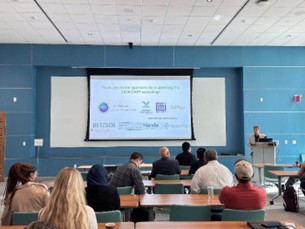
The AAAR Student Chapter at University of Miami was proud to support the 4th Center for Aerosol Science and Technology (CAST) “Summer-in-Winter” Workshop held in Spring 2026 (Jan 15&16) at the University of Miami. This two-day workshop brought together a record 94 registrants from more than 15 states, and featured high-impact tutorials, technical sessions, poster presentations, and hands-on demonstrations that connected fundamental aerosol science with important real-world applications. As the AAAR Student Chapter, we were closely involved in helping with workshop logistics, poster coordination, demonstrations, and overall event support, contributing to a professional, organized, and welcoming environment for all attendees. This workshop also provided valuable opportunities for students to engage with leading researchers, industry representatives, and peers, while recognizing student achievement through poster presentation awards. We are proud that the AAAR Student Chapter could help support an event that strengthened scientific exchange and community within the field of aerosol science.


This Issue’s Newsletter Committee:
Editor | Lindsay Yee, University of California, Berkeley
Editor | Sarah Petters, University of California, Riverside
Senior Assistant Editor | Robert Nishida, University of Waterloo
Senior Assistant Editor | Qian Zhang, UL Research Institutes
Junior Assistant Editor | Jenna Ditto, Washington University in St. Louis