
By Robert Nishida, University of Waterloo
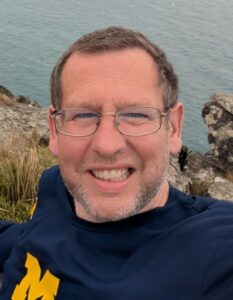
Andrew (Andy) Ault, Ph.D. (Chemistry)
Professor of Chemistry, University of Michigan
Robert: How did you get involved in aerosol science?
Andy: I first got involved with aerosol science as an undergraduate researcher at Carleton College working on an aerosol time-of-flight mass spectrometer (ATOFMS) with Prof. Deborah Gross. The combination of complicated measurements and working in the real world during a study looking at metals in power plant plumes hooked me and set me on a path that has gone in many directions, but always connecting to particles. Continuing to connect with her at AAAR each year is a highlight of the conference for me.
Robert: Which people or programs in our field have been the most influential to you and your path, or who have most influenced your ideas about aerosol science and technology?
Andy: I have been fortunate to have had a series of amazing scientists as mentors during my career, with particular shoutouts to my Ph.D. advisor Prof. Kim Prather at the University of California San Diego (UCSD) and postdoc advisor Prof. Vicki Grassian who I worked for at the University of Iowa, but who is now at UCSD.
Vicki has a real gift for spotting emerging topics of broad importance, from heterogeneous chemistry on dust to nanoparticle health effects to indoor chemistry, at a time when she can get involved and come up with detailed laboratory studies that will provide fundamental understanding of complex topics. She helped me learn how to take what seems like a hopelessly complicated problem and break it down into its constituent parts that could then be studied.
Kim has an amazing ability to synthesize wide ranging concepts and see connections that many who are focused on one silo or another struggle to connect. As I have grown in my own career, I realize that kind of big picture thinking is a special talent and one I hope to emulate. She has applied this to a range of important topics and is able to dive headfirst into multidisciplinary challenges in a fearless way that inspires others.
Both Vicki and Kim have been there for me as I worked towards my goal of being a professor and running my own research group, and I am eternally grateful to them both.
Robert: What are the most exciting research contributions you’ve made so far?
Andy: There are two research directions that our group has been working on that I’m most excited about.
- Measuring aerosol acidity and studying its implications for a range of aerosol processes is where I think my lab has made a contribution. Given the size and complexity of an aerosol, you cannot just stick a pH probe into it to know the acidity, and since any change in water can change pH you can’t just collect it on a filter and measure offline. So often aerosol pH has been thought of as something that can impact a process that a researcher is interested in, but what we have tried to do is flip that by first focusing on measuring the pH and then tackling impacts from an acidity-centric perspective. Through this we have developed multiple measurement approaches, including one that we patented, and applied them to problems from secondary organic aerosol (SOA) to sea spray and dust het chem to biomass burning.
- The second area that has been really exciting is leading the charge to study aerosol from freshwater sources (lakes and rivers), including toxins from harmful algal blooms (HABs) . Having studied sea spray aerosol (SSA) from oceans as a postdoc, when I got to Michigan the summer mantra around the Great Lakes was “No Salt, No Sharks, No Problems”, yet many models just treated Great Lakes aerosols as NaCl the same as SSA. So I showed they are a mix of calcium carbonate and organics and applied methods from oceanography to freshwater including connecting bubble sizes (bigger in freshwater) to aerosol production, then showing these lake spray aerosol (LSA) are transported inland and lofted to cloud heights. More recently we’ve shown that aerosolized toxins from HABs are not present in the same ratio as in lake water and we are working with doctors to study health outcomes and modelers to evaluate exposure risks and impacts on regional air quality and climate. It has been really rewarding to realize something was not being studied and build this into a topic on which others now want to work with us to understand air quality and health in the Midwest.
Robert: What challenges were unexpected as you began and continue to grow your research group?
Andy: I think the most unexpected thing to me was how much of my job would be figuring out how to mentor the members of my group. I hadn’t fully realized how different the mentoring would be from one student to another. I had a naïve idea that if I had a great plan it would work for everyone, and I learned really quickly that this was not the case. However, having learned this, I now really enjoy working with each student to build that mentor-mentee relationship and figure out what they need from me as a mentor to succeed. Not claiming I’ve fully figured it out, I’m still working at it, but I now look forward to working with each student to figure out how I can best help them achieve their goals. In the end, there is nothing more rewarding than when a student graduates and heads off to a career they are excited about and you helped them get there.
Robert: Are there new research directions that you see as particularly important or interesting?
Andy: A research direction that has really exploded for us in the past few years is work on micro- and nanoplastics (MNPs). This area has grown rapidly and focuses on MNPs in everything from air to water to food to blood and organs. We have unique tools, particularly photothermal infrared (PTIR) spectroscopy that let us look at individual MNP particles down to ~400 nm where most researchers are limited to 10’s of microns, so we’re at the cutting edge of this emerging topic. What is really useful for our group is that many key concepts from aerosols, including size distribution interpretation, single particle characterization, understanding heterogeneous chemistry, and the concept of mixing state are important to answering MNP questions, but many in the MNP field do not know about all of the great aerosol work already done in these areas, so it is kind of our cheat code. Overall, it is exciting to be at the forefront of this emerging topic, and I’m really excited to see what we learn about MNPs in the next few years.
Robert: As incoming AAAR president, what are your aims for AAAR in the coming term?
Andy: I have three main goals for my time as president of AAAR.
- The first is to continue to build the positive and supportive culture that AAAR has been known for, from the student attending for the first time to those that attend every year. I am constantly amazed at the loyalty and engagement that AAAR inspires in its members. As the first AAAR president to be born after the organization was founded, I’m constantly impressed by the fact that there are many attendees that have been coming to AAAR since its founding in the early 1980’s. When I now send a student to a conference for the first time it is always AAAR, and I love seeing their excitement at realizing how accessible and welcoming our community is. I hope we all aim to continue working to make our community more inclusive moving forward.
- My second goal is to build stronger connections with the aerosol community in Latin America. Each incoming president is allocated a small pot of money for a project they propose, and my project is helping to fund researchers to attend the AAAR meeting in Pasadena from Colombia, Chile, and Mexico who are part of the Asociación Latinoamericana y del Caribe para Estudios de Aerosoles (ALACEA). Working with Prof. Luis Ladino at UNAM in Mexico City has been fantastic and I look forward to connecting with them and their presentations this year.
- My third goal is to continue the AAAR tradition of maintaining a strong organization that is forward looking and continues to bring in new aerosol aficionados. I’m really excited to work with the rest of the great leadership at AAAR, including the board and past presidents, along with our partners at Virtual to leave AAAR well-positioned heading into the future.
This Issue’s Newsletter Committee:
Editor | Lindsay Yee, University of California, Berkeley
Editor | Sarah Petters, University of California, Riverside
Senior Assistant Editor | Robert Nishida, University of Waterloo
Senior Assistant Editor | Qian Zhang, UL Research Institutes
Junior Assistant Editor | Jenna Ditto, Washington University in St. Louis