
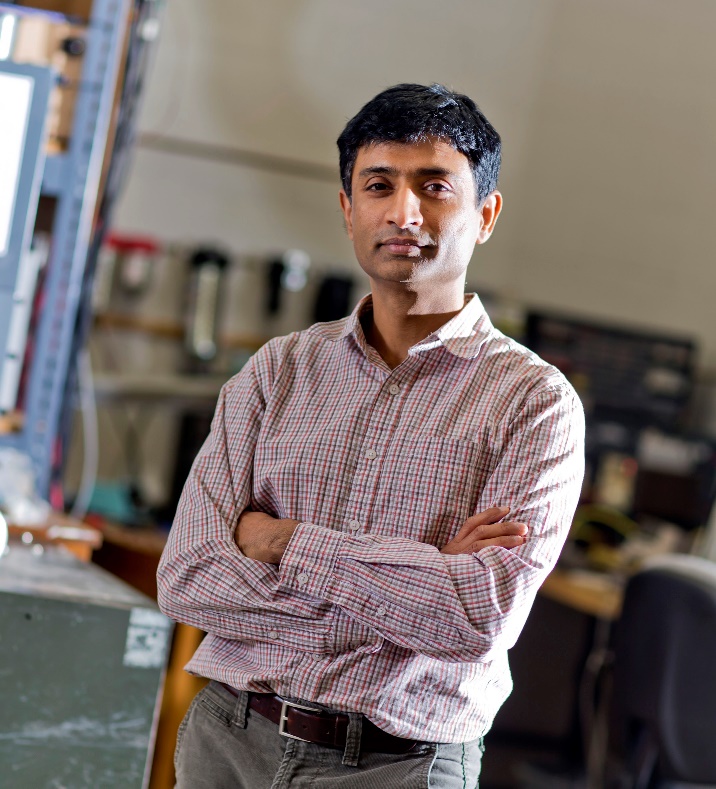
Suresh Dhaniyala, PhD
Bayard D. Clarkson Distinguished Professor
Department of Mechanical and Aeronautical Engineering
Co-Director, Center for Air Resources Engineering and Science (CARES)
Clarkson University
Interviewed by: Qian Zhang, Postdoctoral Researcher at UL Research Institutes, Marietta, GA
QZ: How did you get involved in the aerosol science community?
SD: I attended my first AAAR conference in 1994, which was an international aerosol conference held in Los Angeles, CA. I have since attended almost every AAAR conference. My first volunteering experience in AAAR was as a student assistant in 1994. I subsequently had the opportunity to serve in different working groups, committees, and on the board.
QZ: Which people or programs in our field have been the most influential to you and your path, or who have most influenced your ideas about aerosol research?
SD: I have been fortunate to have many mentors and supporters in every stage of my career. My introduction to aerosol science was through Tony Wexler, during my master’s at the Univ. of Delaware. During my PhD with Benjamin Liu at the University of Minnesota, I was introduced to experimental aerosol mechanics, microelectronics, and filtration. My post-doc advisers, Rick Flagan and Paul Wennberg opened up the field of aircraft measurements and stratospheric aerosol to me. My current research direction and philosophy are an amalgamation of the diverse experiences and guidance I have been lucky to receive.
QZ: What is the most interesting research contribution you’ve made so far?
SD: Interesting? That would be our work in predicting ambient air quality from analysis of Tweets! That gave us a flavor of the power of language models before LLM became common place in our life.
QZ: What challenges were completely unexpected as you began and continue to grow your own research group?
SD: Building a research group in academia comes with challenges associated with uncertainty in funding and student recruitment. While this is not unexpected, the simultaneous and severe challenge that we are currently facing on both these fronts, is of a magnitude that is unexpected and a challenge for our growth.
QZ: Are there new research directions that you see as particularly important or interesting?
SD: Aerosol science has been referred to as an enabling science and that is partly because of the tools that we develop. I expect that our development of tools will take new directions and see significant growth in the coming years. The recent advances in electronics, light sources, data science, and computing power will drive the emergence of new sensors that are not just miniature in size and affordable, but also near-research grade. These sensors will transform our ability to more widely probe and monitor our environment and democratize measurements beyond PM2.5.
This Issue’s Newsletter Committee:
Editor | Sarah Petters, University of California, Riverside
Senior Assistant Editor | Lindsay Yee, University of California, Berkeley
Junior Assistant Editor | Qian Zhang, UL Research Institutes
Junior Assistant Editor | Robert Nishida, University of Waterloo