
By Qian Zhang, UL Research Institutes
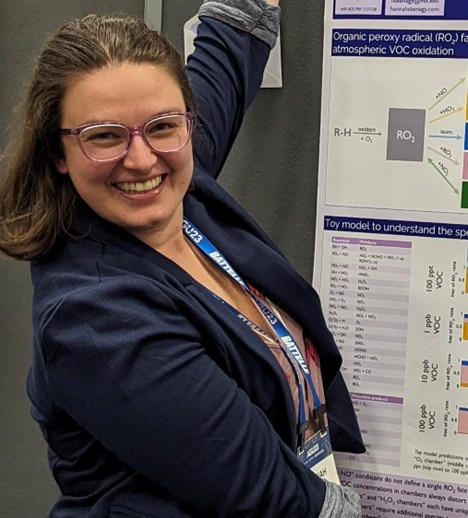
Dr. Hannah S. Kenagy Assistant Professor, Department of Chemistry University of Minnesota
To learn more about Dr. Hannah Kenagy’s research: https://kenagy.chem.umn.edu/
Qian: How did you get involved in the aerosol science community?
Hannah: As a student, most of my work was in gas-phase atmospheric chemistry: stratospheric chemistry as an undergrad and then tropospheric chemistry in grad school. Towards the end of my PhD, I became interested in the chemistry that controls how gas-phase species get incorporated in the particle phase, and the final project I worked on in grad school focused on the production of the secondary organic aerosols (SOA) in urban areas.
As a post-doc, I was excited to continue work on SOA chemistry and explore the links between gas-phase oxidation chemistry and aerosol production. SOA is a significant, and sometimes dominant, portion of the global aerosol burden and has impacts on both human health and the earth’s radiative balance. And despite decades of intensive research on SOA formation, current large-scale models are unable to reproduce the observed variability in atmospheric organic aerosol. Understanding the chemistry of SOA formation is key to solving this problem; this was a large focus of my postdoctoral work and continues to be a focus in my research group at UMN.
Qian: Which people or programs in our field have been the most influential to you and your path, or who have most influenced your ideas about aerosol research?
Hannah: I’ll shout-out three fabulous research advisors here: Ron Cohen, who taught me how to interpret atmospheric observations in ways that give us chemical insights; Colette Heald, who taught me how to think about the nuances of modeling atmospheric aerosols; and Jesse Kroll, who taught me how to use laboratory experiments to advance our understanding of aerosol chemistry. More importantly than each of those skillsets, though, each of them always encouraged me to focus on the big picture, showed me how fun science can be, and demonstrated for me how to be an effective mentor and advocate.
In addition to crediting my mentors, I’d like to acknowledge the many hallway conversations I’ve had with many friends and colleagues at AAAR meetings. I’ve learned so much from those, however short, and always appreciate the opportunity to share ideas and insights.
Qian: What is the most interesting research contribution you’ve made so far?
Hannah: During my time as a post-doc at MIT, I had the opportunity to work with both experimentalists and modelers. Together, we tried to understand how we could use models to design better lab experiments of SOA formation. Because descriptions of SOA formation chemistry in regional and global models of the atmosphere are based on lab experiments, the limitations of our experiments become the limitations of our models. As such, mimicking atmospheric chemical conditions in the lab is essential for ensuring accurate model predictions of air quality and climate.
In this work, we used multi-scale modeling to demonstrate that the chemical environments achieved in previous lab studies of SOA production did not overlap with the atmospheric chemical environment, and we developed strategies and approaches for improving that overlap in environmental chamber studies. Working at this interface between modeling and experiments was a lot of fun and I think demonstrates that we can push aerosol science forward in collaborations like these.
Qian: What challenges were completely unexpected as you began and continue to grow your own research group?
Hannah: Perhaps I shouldn’t have been surprised by this, but it turns out that lab renovations are complicated, take time, and involve a lot of different people–including, but not limited to, architects, electricians, plumbers, building code enforcers, environmental health and safety folks, purchasing officers, and grad students. And there were so many small details to figure out, many of which were things I had never thought about before! My students and I are so excited for when it’s all finished, and we get to do science in the space we all worked so hard to get built.
Qian: What is the most exciting current research project you are working on?
Hannah: Our lab will have an environmental chamber for doing studies of SOA formation chemistry, and as our lab renovation gets closer and closer to being finished, we are all getting more and more excited about planning our first sets of (model-informed!) experiments. We’re also in the planning stages for some new field observations—in places where measurements are sparse as well as in places where measurements were made a decade or two ago but where the emissions and hence aerosol chemistry have changed substantially in the meantime!
Qian: Are there new research directions that you see as particularly important or interesting?
Hannah: I’m particularly interested in the chemistry of atmospheric aerosols, and the atmosphere is of course a dynamic, ever-changing reaction vessel! As we continue to see changes in emissions and temperatures, the chemistry controlling aerosol production will also continue to change. Understanding these changes is essential for climate and air quality predictions going forward and I think is an exciting area for research right now.
This Issue’s Newsletter Committee:
Editor | Lindsay Yee, University of California, Berkeley
Editor | Sarah Petters, University of California, Riverside
Senior Assistant Editor | Robert Nishida, University of Waterloo
Senior Assistant Editor | Qian Zhang, UL Research Institutes
Junior Assistant Editor | Jenna Ditto, Washington University in St. Louis